

Epic Systems dominates large hospital IT, but is it the right choice for every facility? This comparison examines how HospitalOS provides an alternative for hospitals seeking enterprise features without enterprise costs.
Quick Comparison
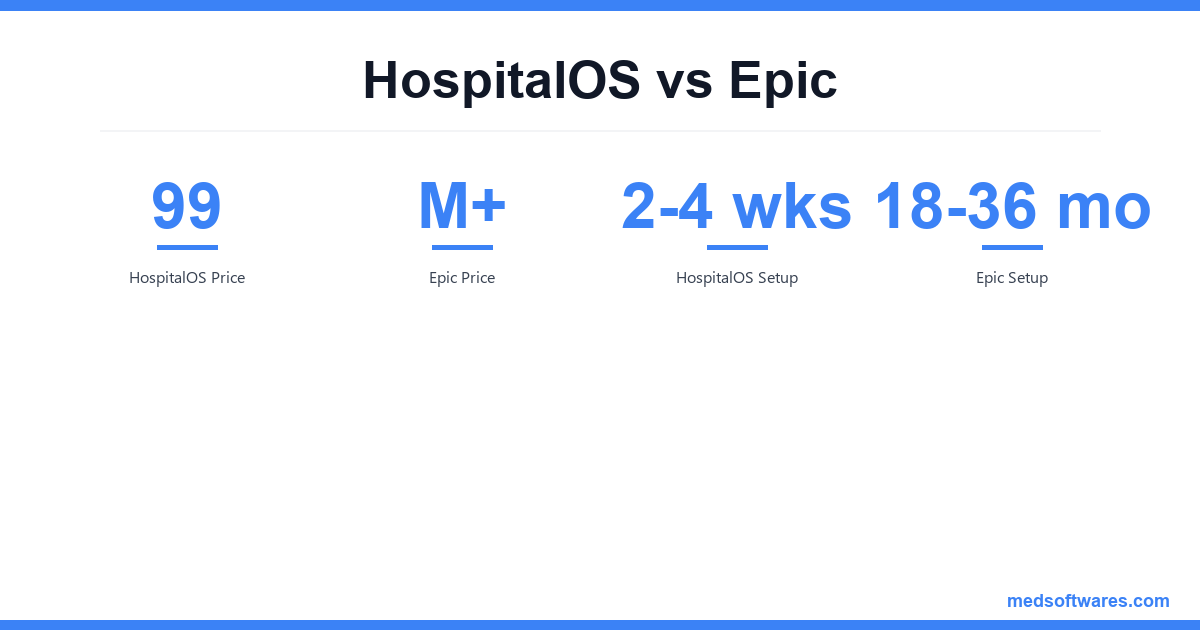
| Factor | HospitalOS | Epic | |--------|------------|------| | Target Market | Community hospitals, clinics | Large health systems | | Pricing | One-time license | $1M+ implementation | | Annual Cost | $0-2,000 | $100,000+ | | Implementation | 4-8 weeks | 18-36 months | | IT Staff Needed | 1-2 | 10-50+ | | Offline Mode | Yes | No | | International | Yes | Yes (limited) |
Pricing Reality Check
HospitalOS Costs
- License: $5,000-$50,000 one-time
- Implementation: $2,000-$10,000
- Annual Support: $0-$2,000
- 5-Year TCO: $10,000-$70,000
Epic Costs
- License: $500,000-$5,000,000+
- Implementation: $500,000-$2,000,000+
- Annual Support: $100,000-$500,000+
- 5-Year TCO: $2,000,000-$10,000,000+
The Reality: Epic costs 50-100x more than HospitalOS.
Who Should Choose Each
Choose HospitalOS If:
- You're a community hospital (under 200 beds)
- Budget is a primary consideration
- You need quick implementation
- You operate internationally
- You need offline capability
- IT resources are limited
- You're a clinic or outpatient facility
Choose Epic If:
- You're a large health system (500+ beds)
- You have $2M+ IT budget
- You can wait 2+ years for implementation
- You have 20+ IT staff
- You need complex specialty modules
- Interoperability with other Epic facilities is critical
Feature Comparison
| Module | HospitalOS | Epic | |--------|------------|------| | OPD/Clinic | Yes | Yes | | IPD/Inpatient | Yes | Yes | | Emergency | Yes | Yes | | Pharmacy | Yes | Yes | | Laboratory | Yes | Yes | | Radiology | Yes | Yes | | Billing | Yes | Yes | | EMR | Yes | Yes | | Offline Mode | Yes | No | | Mobile Access | Yes | Yes |
Both systems cover core hospital modules. The difference is scale, complexity, and cost.
Implementation Comparison
| Factor | HospitalOS | Epic | |--------|------------|------| | Timeline | 4-8 weeks | 18-36 months | | Training | Days-Weeks | Months | | Staff Required | 1-2 | Dozens | | Disruption | Minimal | Significant | | Go-Live Risk | Low | High |
The 200-Bed Rule
Under 200 beds: Epic is almost certainly overkill. The cost, complexity, and implementation time don't justify the benefits for smaller facilities.
Over 500 beds: Epic's scale and specialty modules may justify the investment, especially for academic medical centers.
200-500 beds: Evaluate carefully. HospitalOS may still be the better value.
International Considerations
HospitalOS International Advantages:
- Multi-currency support
- Multi-language interfaces
- Local regulatory compliance
- Offline capability (essential in many markets)
- Local payment integration
- Affordable for developing market facilities
Epic International Limitations:
- US-centric design
- Expensive for international markets
- Limited developing market presence
- Internet-dependent
Real Cost Example
50-Bed Community Hospital - 5 Year Comparison:
| Cost Category | HospitalOS | Epic | |--------------|------------|------| | Software | $15,000 | $1,500,000 | | Implementation | $5,000 | $500,000 | | Annual Support | $5,000 | $500,000 | | IT Staff | $0 (existing) | $300,000 | | 5-Year Total | $25,000 | $2,800,000 |
Savings with HospitalOS: $2,775,000
Conclusion
Epic is the right choice for large health systems with deep pockets and complex needs. For everyone else—community hospitals, clinics, international facilities—HospitalOS delivers the features you need at a price that makes sense.
Request HospitalOS Demo | View Modules


