

Physiotherapy and rehabilitation clinics in 2026 operate in an increasingly demanding environment where clinical excellence, operational efficiency, and financial sustainability must coexist. Whether you run a single-location physical therapy practice, a multi-site rehabilitation clinic, or an outpatient occupational therapy or speech therapy center, the right software platform can transform your operations. Modern physiotherapy software goes far beyond simple scheduling, offering exercise prescription libraries, outcome measurement tools, SOAP documentation, insurance billing automation, and patient engagement features that drive better outcomes and stronger revenue.
This guide evaluates the leading PT practice management and rehabilitation EHR solutions for 2026, helping you choose the platform that best fits your clinic's needs.
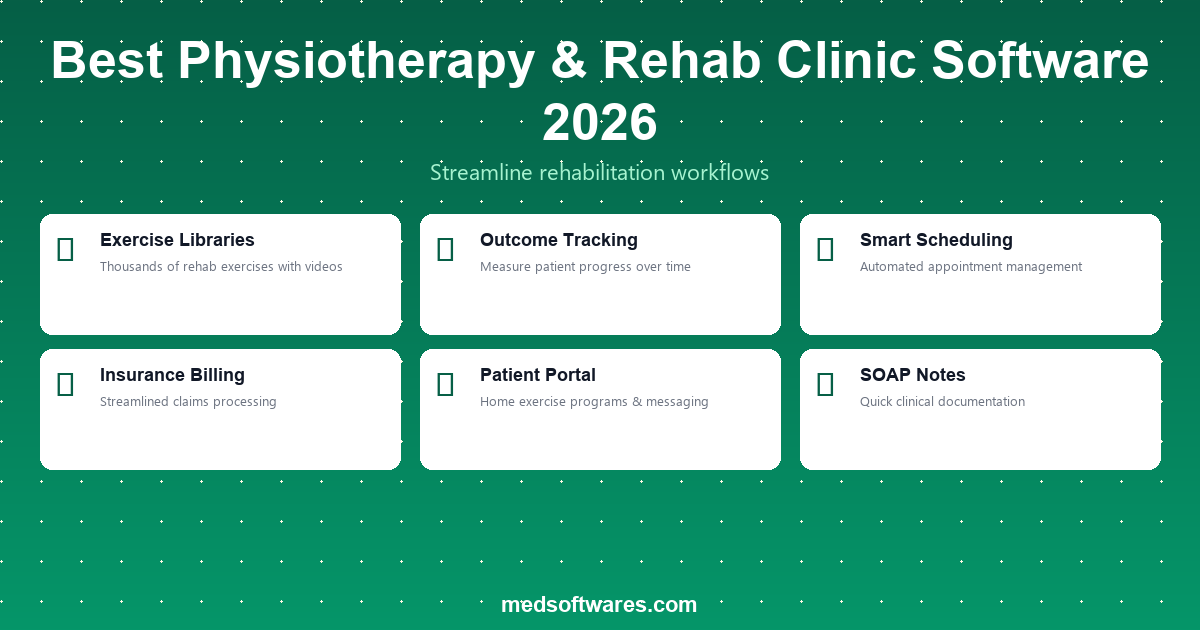
Quick Comparison: Top Physiotherapy Software 2026
| Software | Best For | Exercise Library | Outcome Tracking | HEP | Pricing | |---|---|---|---|---|---| | WebPT | Mid-large PT practices | Built-in | Yes | Yes | From $3/visit | | Clinicient (WebPT) Insight | Enterprise rehab | Built-in | Yes | Yes | Custom | | TheraOffice | Small-mid PT clinics | Yes | Yes | Yes | Custom | | Net Health (ReDoc/Optima) | Hospital outpatient rehab | Yes | Advanced | Yes | Custom | | Prompt EMR | Modern PT startups | Yes | Yes | Yes | From $150/mo | | Jane App | Allied health (global) | Yes | Basic | Yes | From $54/mo | | HospitalOS | Integrated hospital rehab | Configurable | Yes | Configurable | One-time license |
Why Rehab Clinics Need Specialized Software
Limitations of General EHR Systems
Standard medical EHR systems fail rehabilitation clinics in several critical ways:
- No therapy-specific documentation: General systems lack SOAP note templates designed for physical, occupational, and speech therapy
- No exercise prescription tools: Cannot create, customize, and deliver home exercise programs (HEPs) with video demonstrations
- Inadequate outcome tracking: Missing standardized functional outcome measures (FOTO, OPTIMAL, Oswestry)
- Poor scheduling flexibility: Cannot handle therapy-specific scheduling patterns (30-, 45-, 60-minute slots, concurrent patients, group therapy)
- Limited billing support: Lack therapy-specific billing rules (8-minute rule, modifier tracking, timed vs. untimed codes)
- No productivity tracking: Cannot monitor therapist units per visit, cancellation rates, or arrival rates
The Financial Imperative
Rehabilitation practices operate on tight margins, making software-driven efficiency critical:
| Metric | Industry Benchmark | Software Impact | |---|---|---| | Cancellation rate | <10% | Automated reminders reduce by 30-50% | | Units per visit | 3.5-4.5 | Documentation prompts maximize capture | | Days in A/R | <35 days | Claim scrubbing reduces denials | | Authorization denials | <5% | Tracking prevents expired authorizations | | Patient retention | >80% completion | HEP engagement improves adherence | | Therapist productivity | 85-90% utilization | Smart scheduling optimizes caseload |
Essential Features of Physiotherapy Software
1. Clinical Documentation (SOAP Notes)
The cornerstone of rehabilitation EHR functionality is efficient, compliant documentation:
Initial Evaluation:
- Patient history: Chief complaint, mechanism of injury, prior treatment, surgical history
- Systems review: Cardiovascular, musculoskeletal, neuromuscular, integumentary
- Tests and measures: Range of motion, manual muscle testing, special tests, functional mobility
- Assessment: Clinical impression, ICD-10 diagnosis, physical therapy diagnosis
- Plan of care: Treatment frequency and duration, short-term and long-term goals, interventions planned
- Medical necessity documentation: Justify skilled therapy services for insurance authorization
Daily SOAP Notes:
- Subjective: Patient-reported symptoms, pain levels, functional changes
- Objective: Interventions performed with CPT codes and minutes, vital signs, clinical measurements
- Assessment: Progress toward goals, response to treatment, clinical reasoning
- Plan: Next session focus, home exercise compliance, modifications to plan of care
Progress Reports (Every 10 Visits or 30 Days):
- Objective re-assessment of baseline measurements
- Goal progress documentation (met, progressing, modified, discontinued)
- Continued medical necessity justification
- Updated plan of care with remaining visit estimates
Discharge Summary:
- Final functional outcome measurements
- Goal achievement documentation
- Home exercise program for maintenance
- Referral recommendations
- Patient satisfaction survey
2. Exercise Libraries and Home Exercise Programs (HEP)
Exercise prescription is unique to rehabilitation software:
Exercise Library Features:
- Pre-built libraries: 5,000-10,000+ exercises with professional photos and videos
- Categorization: By body region, diagnosis, difficulty level, equipment required
- Custom exercises: Upload clinic-specific exercises with custom photos/videos
- Evidence-based protocols: Standardized programs for common diagnoses (ACL rehab, rotator cuff, total knee)
- Progression tracking: Automatically progress exercises based on patient performance
Home Exercise Program (HEP) Delivery:
- Digital delivery: Email, text, or patient app with video demonstrations
- Print-ready handouts: Professional PDF with illustrations and instructions
- Multilingual support: Exercise instructions in multiple languages
- Patient logging: Patients record completion, pain levels, and difficulty ratings
- Adherence tracking: Clinicians monitor compliance between visits
- Outcome correlation: Link HEP adherence to functional outcome improvements
3. Outcome Measurement and Tracking
Measurement-based practice is increasingly required by payers and accreditation bodies:
Common Rehabilitation Outcome Measures:
| Measure | Body Region / Condition | Scoring | |---|---|---| | Oswestry Disability Index (ODI) | Low back pain | 0-100% disability | | Neck Disability Index (NDI) | Neck pain | 0-100% disability | | DASH/QuickDASH | Upper extremity | 0-100 disability | | LEFS (Lower Extremity Functional Scale) | Lower extremity | 0-80 function | | KOOS/HOOS | Knee/hip | 0-100 subscales | | Berg Balance Scale | Balance/fall risk | 0-56 | | Timed Up and Go (TUG) | Mobility/fall risk | Seconds | | 6-Minute Walk Test | Endurance/cardiopulmonary | Meters walked | | FIM (Functional Independence Measure) | Global function (inpatient rehab) | 18-126 | | FOTO Measures | Multiple (risk-adjusted) | Standardized scores |
Software Capabilities:
- Automated administration: Push outcome measures to patients via portal before or after visits
- Real-time scoring: Instant calculation with interpretation and normative comparison
- Trend visualization: Graphical progress displays showing change over episodes of care
- MCID flagging: Identify when patients achieve Minimal Clinically Important Difference
- Predictive analytics: Forecast expected outcomes based on diagnosis, acuity, and patient demographics
- Payer reporting: Generate outcome reports for insurance companies and utilization review
4. Scheduling and Patient Flow
Rehabilitation clinics have unique scheduling requirements:
- Flexible time slots: 30, 45, or 60-minute sessions; configurable by therapist and visit type
- Concurrent patient management: Schedule 2-3 patients simultaneously per therapist with staggered start times
- Automated waitlist: Fill cancellations automatically from prioritized patient waitlists
- Recall management: Alert patients due for follow-up or annual wellness visits
- Multi-discipline scheduling: Coordinate PT, OT, and SLP appointments for patients receiving multiple services
- Online self-scheduling: Allow patients to book directly through website or patient portal
- Automated reminders: SMS, email, and phone call reminders sent 24-48 hours before appointments
- No-show tracking: Monitor and flag patients with repeated missed appointments for outreach
- Therapist utilization dashboards: Real-time visibility into caseload, cancellations, and available slots
5. Insurance Billing and Revenue Cycle
Rehabilitation billing requires specialized knowledge and tools:
Common PT/OT/SLP CPT Codes:
| Code | Description | Timed? | Typical Units | |---|---|---|---| | 97110 | Therapeutic exercise | Yes (15 min) | 1-4 | | 97112 | Neuromuscular re-education | Yes (15 min) | 1-3 | | 97116 | Gait training | Yes (15 min) | 1-2 | | 97140 | Manual therapy | Yes (15 min) | 1-4 | | 97161-97163 | PT evaluation (low/mod/high) | Untimed | 1 | | 97530 | Therapeutic activities | Yes (15 min) | 1-3 | | 97542 | Wheelchair management | Yes (15 min) | 1-2 | | 92507 | Speech therapy treatment | Untimed | 1 | | 97035 | Ultrasound | Yes (15 min) | 1 | | 97010 | Hot/cold packs | Untimed | 1 |
8-Minute Rule Compliance:
- Software automatically calculates proper units based on documented treatment times
- Visual timers and alerts prevent under-billing and over-billing
- Total timed minutes displayed with unit conversion in real-time
Billing Automation Features:
- Automatic charge capture: CPT codes and units generated from documentation
- Authorization tracking: Monitor approved visits remaining and alert before expiration
- Claim scrubbing: Pre-submission error checking for coding, modifier, and documentation requirements
- ERA/EOB auto-posting: Electronic remittance processing with payment variance flagging
- Denial management: Automated denial categorization, appeal letter templates, and resubmission
- Patient responsibility estimation: Real-time copay and deductible calculation at check-in
- Batch billing: Submit claims for multiple patients and dates of service simultaneously
- Medicare therapy cap tracking: Monitor against MIPS thresholds and KX modifier requirements
6. Patient Portal and Engagement
A powerful patient portal improves retention and outcomes:
- Appointment management: Book, reschedule, or cancel appointments online
- Intake forms: Digital completion of medical history, consent forms, and insurance information
- HEP access: View and log home exercise programs with video demonstrations
- Outcome measures: Complete questionnaires before visits to save in-clinic time
- Secure messaging: Communicate with care team between visits
- Billing and payments: View statements and make payments online
- Educational content: Access condition-specific articles and videos
- Satisfaction surveys: Post-discharge feedback collection
7. Reporting and Analytics
Data-driven practice management requires robust analytics:
- Financial reports: Revenue by payer, procedure, provider, and location
- Productivity dashboards: Units per visit, visits per day, cancellation and no-show rates
- Outcome reports: Average improvement by diagnosis, provider outcome benchmarking
- Referral tracking: Volume by referring provider, conversion rates, and relationship management
- Authorization reports: Expired authorizations, denied visits, and underutilized approvals
- KPI dashboards: Real-time display of key performance indicators for clinic managers
Top Physiotherapy Software Solutions in 2026
1. WebPT
Market Position: The largest therapy-specific EMR platform, serving over 150,000 therapy professionals.
Key Strengths:
- Purpose-built for outpatient rehabilitation (PT, OT, SLP)
- Extensive exercise library with HEP builder
- Strong documentation compliance tools for Medicare and commercial payers
- Integrated billing and revenue cycle management
- Outcome tracking with FOTO integration
- Large user community and extensive training resources
- Marketplace of integrations for scheduling, patient engagement, and analytics
Pricing: Per-visit pricing model starting at approximately $3/visit.
Considerations:
- Per-visit pricing can become expensive for high-volume clinics
- Best suited for outpatient private practice; less ideal for hospital-based programs
- Interface has evolved but may feel less modern than newer competitors
2. Net Health (ReDoc / Optima Therapy)
Market Position: Enterprise-grade rehabilitation platform for hospital-based and multi-site programs.
Key Strengths:
- Comprehensive across inpatient rehab, outpatient, home health, and contract therapy
- Advanced outcome analytics and benchmarking
- Strong compliance tools for IRF-PAI, MDS Section O, and OASIS
- Integration with hospital EHR systems (Epic, Cerner, Meditech)
- Workforce management and productivity tools
- Robust reporting for large rehabilitation departments
Pricing: Custom enterprise pricing.
Considerations:
- Primarily designed for larger organizations
- Higher cost structure than private practice platforms
- Implementation complexity for multi-site deployments
3. Prompt EMR
Market Position: Fast-growing modern platform built for the next generation of PT practice owners.
Key Strengths:
- Modern, clean user interface with intuitive workflows
- All-in-one platform: EMR, billing, scheduling, HEP, patient portal
- Built-in exercise library with video demonstrations
- Strong automation capabilities reducing administrative burden
- Transparent pricing without per-visit fees
- Rapid feature development and responsive to user feedback
Pricing: Starting at $150/month per provider (includes all features).
Considerations:
- Newer platform with smaller user base than WebPT
- Still building out some enterprise features
- Primarily focused on outpatient PT
4. Jane App
Market Position: Popular allied health platform, especially strong in Canada, Australia, and the UK.
Key Strengths:
- Beautiful, intuitive design loved by users
- Multi-discipline support (PT, OT, chiropractic, massage, naturopathy)
- Online booking with website integration
- Integrated payment processing
- Charting templates with customization
- Telehealth built-in
- Strong international presence with multi-currency support
Pricing: Starting at $54/month (Base plan) with volume-based pricing.
Considerations:
- Insurance billing tools less robust for US market
- Exercise library less comprehensive than therapy-specific platforms
- Outcome measurement tools are basic compared to WebPT or Prompt
- Better suited for cash-pay or international practices
5. TheraOffice
Market Position: Established therapy practice management system for small-to-mid-size clinics.
Key Strengths:
- Comprehensive therapy-specific functionality
- Strong scheduling with multi-therapist support
- Built-in billing with clearinghouse integration
- Exercise prescription and HEP tools
- Outcome tracking and reporting
- Good value for smaller practices
Pricing: Custom pricing based on clinic size and modules.
Considerations:
- Interface showing its age compared to modern platforms
- Cloud migration still in progress for some features
- Smaller vendor with limited R&D compared to WebPT or Net Health
6. HospitalOS
Market Position: Integrated hospital management platform with rehabilitation clinic capabilities, ideal for global markets.
Key Strengths:
- One-time licensing model eliminates recurring per-provider or per-visit fees
- Integrated rehabilitation module within a comprehensive hospital system
- Configurable SOAP note templates for PT, OT, and SLP documentation
- Appointment scheduling with multi-discipline coordination
- Pharmacy integration via PharmaPos for medication management
- Multi-language support for international rehabilitation clinics
- Offline functionality for clinics with unreliable internet connectivity
- Scalable from single clinic to multi-site rehabilitation networks
Ideal For:
- Hospital-based outpatient rehabilitation departments
- Rehabilitation clinics in Africa, Asia, Latin America, and the Caribbean
- Organizations wanting integrated medical and rehabilitation records
- Facilities seeking affordable alternatives to subscription-based platforms
How to Choose the Right Physiotherapy Software
Step 1: Define Your Clinic Profile
- Discipline mix: PT only, or PT + OT + SLP?
- Practice setting: Outpatient private practice, hospital-based, home health, or hybrid?
- Clinic size: Solo practitioner, small group (2-5 therapists), or multi-site enterprise?
- Patient volume: Average daily visits per therapist?
- Payer mix: Insurance-dominant, cash-pay, workers' comp, or mixed?
- Geography: US-based (insurance billing critical) or international (cash-pay common)?
Step 2: Rank Your Feature Priorities
| Feature | Solo PT | Group Practice | Hospital Outpatient | |---|---|---|---| | SOAP notes | Critical | Critical | Critical | | Exercise library / HEP | Critical | Critical | Important | | Insurance billing | Critical | Critical | Integrated with hospital | | Scheduling | Important | Critical | Critical | | Outcome tracking | Important | Critical | Critical | | Patient portal | Important | Critical | Important | | Multi-site management | N/A | Critical | Critical | | Analytics / reporting | Basic | Advanced | Advanced | | EHR integration | N/A | N/A | Critical |
Step 3: Calculate Total Cost of Ownership
Per-visit pricing example (WebPT):
- 30 visits/day x 250 days/year x $3/visit = $22,500/year per clinic
Per-provider pricing example (Prompt):
- 5 therapists x $150/month x 12 months = $9,000/year
One-time license example (HospitalOS):
- One-time investment with no recurring license fees
- Annual support and updates at a fraction of subscription costs
Step 4: Evaluate Integration Needs
- Existing hospital EHR: Does the therapy software integrate with Epic, Cerner, or your current system?
- Billing clearinghouse: Is your preferred clearinghouse supported?
- Exercise library: Can you import custom exercises and protocols?
- Patient engagement tools: Does the portal meet your patients' expectations?
- Outcome registries: Can you submit data to FOTO, OPTIMAL, or AAOS registries?
Key Trends in Rehabilitation Software 2026
AI-Powered Documentation
Artificial intelligence is reducing the documentation burden on therapists:
- Ambient documentation: AI listens during sessions and drafts SOAP notes for therapist review
- Auto-coding: Natural language processing identifies CPT codes from treatment descriptions
- Goal writing assistance: AI suggests measurable, functional goals based on diagnosis and evaluation findings
- Predictive discharge planning: AI estimates optimal number of visits based on patient profile and historical outcomes
Remote Therapeutic Monitoring (RTM)
CMS RTM codes (98975-98981) are creating new revenue opportunities:
- Digital exercise programs: Prescribe and monitor home exercises through connected apps
- Wearable integration: Track movement data, step counts, and activity levels between visits
- Asynchronous communication: Therapists review patient-reported data and adjust programs remotely
- Revenue generation: RTM codes provide reimbursement for between-visit monitoring ($50-$150/month per patient)
Telerehabilitation
Virtual therapy services continue to mature:
- Live video sessions: Real-time therapy sessions with guided exercise
- Asynchronous coaching: Review patient exercise videos and provide feedback
- Hybrid care models: Combine in-person and virtual visits for optimal convenience and outcomes
- Wearable biofeedback: Real-time movement analysis during telerehab sessions
Value-Based Payment Models
Rehabilitation is transitioning from volume to value:
- Episode-based bundled payments: Fixed reimbursement for complete episodes of care (e.g., total knee rehab)
- Outcome-based incentives: Bonus payments for achieving defined functional improvements
- Risk stratification: Software helps identify patients at risk for poor outcomes early in treatment
- Cost transparency: Tools to track cost per episode and optimize resource allocation
Why Consider HospitalOS for Rehabilitation Clinics
HospitalOS provides rehabilitation clinics with a powerful, cost-effective alternative to traditional subscription-based platforms:
- Predictable costs: A one-time license fee means no surprise price increases, no per-visit charges, and no per-therapist monthly fees that scale with growth
- Integrated care: When rehabilitation services are part of a hospital or multi-specialty clinic, HospitalOS provides unified medical records across all departments
- Pharmacy support: PharmaPos handles medication dispensing for patients requiring pain management or anti-inflammatory medications during rehabilitation
- Global deployment: Multi-language, multi-currency support makes HospitalOS ideal for rehabilitation clinics worldwide, including rapidly growing markets in Africa, Asia, and Latin America
- Offline resilience: Continue scheduling, documenting, and managing patients even when internet is unavailable
Contact MedSoftwares today to schedule a demo and discover how HospitalOS can elevate your rehabilitation clinic operations.
![Clinic Appointment Scheduling Software: Complete Guide [2026]](/_next/image?url=%2Finfographics%2Fclinic-scheduling-benefits-2026.png&w=2048&q=75)
![mHealth Mobile Apps for Hospitals & Clinics: Complete Guide [2026]](/_next/image?url=%2Finfographics%2Fmhealth-apps-market-2026.png&w=2048&q=75)
