

Fertility clinics and IVF centers operate in one of the most complex and sensitive areas of healthcare. Managing intricate treatment cycles, embryology laboratory workflows, gamete and embryo chain-of-custody, donor programs, detailed consent processes, and rigorous outcome reporting demands specialized software that general practice management systems simply cannot provide. In 2026, fertility clinic management software has matured into comprehensive platforms that integrate clinical, laboratory, financial, and regulatory workflows into a single system -- ensuring accuracy, compliance, and the best possible patient outcomes.
Quick Comparison: Top Fertility Clinic Software Platforms
| Platform | Best For | Key Strength | Pricing Model | SART Reporting | |----------|----------|-------------|---------------|----------------| | eIVF (PracticeHwy) | Large IVF centers | Comprehensive IVF workflows | Per-provider/month | Yes | | AIVF / EggDonorConnect | AI-powered embryo selection | AI embryo grading | Custom pricing | Yes | | IVFqc | Lab quality control | Embryology QC focus | Per-lab/month | Yes | | Meditex IVF | European clinics | HFEA & EU compliance | Per-clinic/month | EU reporting | | CARE Fertility Systems | Multi-site fertility groups | Multi-location management | Per-site/month | Yes | | HospitalOS | Integrated fertility + hospital | HMS integration | One-time license | Configurable | | Fertility Cloud | Small-mid practices | Cloud simplicity | SaaS monthly | Yes | | INVOcell / Praxis EMR | Boutique clinics | Customizable templates | Per-provider/month | Partial |
The Fertility Industry Landscape 2026
Market Overview
The fertility and reproductive health sector is experiencing unprecedented growth:
- IVF cycles performed annually (US): 400,000+ (growing 10-15% year-over-year)
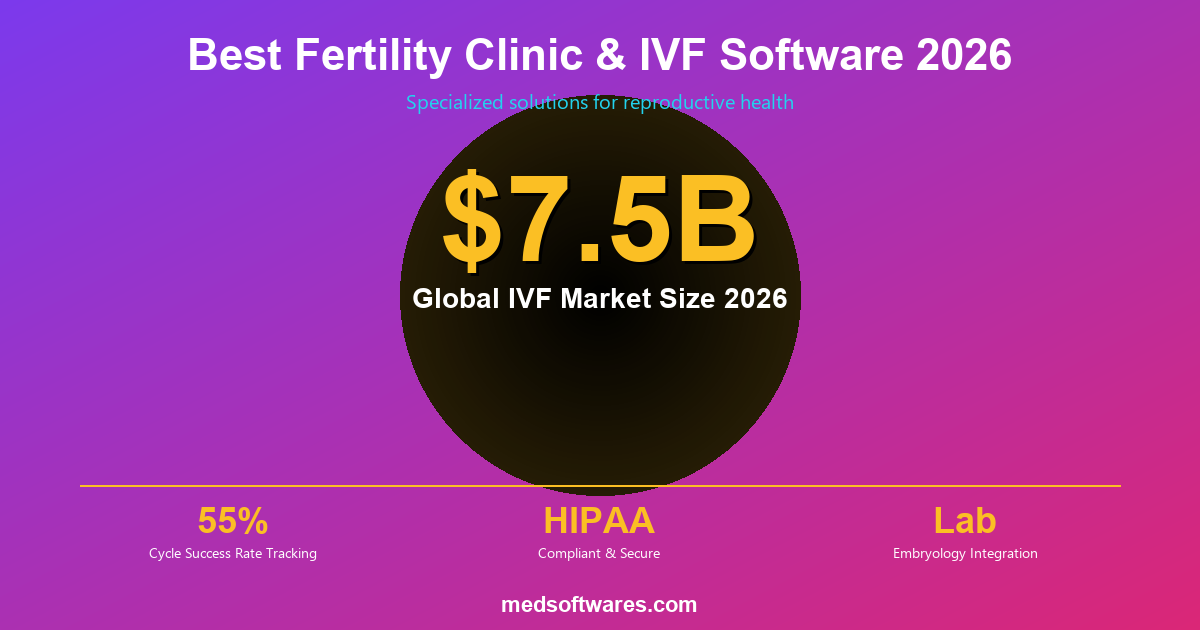
- Global IVF market: Projected to reach $45 billion by 2030
- Number of US fertility clinics: 550+ SART-member clinics
- Average IVF cycle cost: $15,000 - $30,000 (before medication)
- Success rates: 40-55% live birth rate per transfer for patients under 35
- Frozen embryo transfers: Now exceed fresh transfers in most clinics
Growth Drivers:
- Delayed childbearing trends (average maternal age at first birth: 30.4 years)
- Employer fertility benefits now offered by 40%+ of large employers
- Social egg freezing demand growing 25%+ annually
- Same-sex couples and single parents by choice expanding the patient base
- Improved technology increasing success rates and public awareness
Regulatory Environment
SART (Society for Assisted Reproductive Technology):
- Mandatory outcome reporting for member clinics
- Annual pregnancy and live birth rate reporting per age group
- Clinic comparison data published on sart.org
- Quality benchmarks and practice guidelines
FDA Regulations:
- Tissue establishment registration for gamete and embryo handling
- Current Good Tissue Practice (cGTP) compliance
- Donor eligibility testing requirements
- Adverse event reporting
State Regulations:
- Insurance mandate compliance (20+ states require fertility coverage)
- Embryo disposition laws (vary significantly by state)
- Surrogacy regulations
- Donor anonymity rules and disclosure requirements
CLIA/CAP Certification:
- Laboratory certification for andrology and embryology labs
- Proficiency testing requirements
- Quality assurance program documentation
- Personnel qualifications tracking
Essential Features of Fertility Clinic Software
1. IVF Cycle Management
Cycle Tracking Dashboard:
- Real-time cycle status for all active patients (stimulation, retrieval, transfer, TWW)
- Visual timeline showing treatment milestones and upcoming events
- Color-coded status indicators (on-track, delayed, cancelled, pregnant)
- Multi-cycle history with outcome comparisons
- Provider caseload views and daily procedure schedules
Stimulation Protocol Management:
- Protocol templates (antagonist, long lupron, mini-IVF, natural cycle)
- Medication dosing schedules with auto-calculation based on patient parameters
- Dose adjustment workflows triggered by monitoring results
- Cost estimation per protocol for patient financial counseling
- Protocol outcome analytics for continuous improvement
Monitoring and Trigger:
- Ultrasound findings documentation (follicle counts, sizes, endometrial thickness)
- Estradiol, LH, and progesterone lab result integration
- Automated trigger criteria alerts (lead follicle size, estradiol levels)
- Trigger medication orders (hCG, Lupron trigger, dual trigger)
- Retrieval scheduling based on trigger timing
Cycle Outcomes:
- Number of oocytes retrieved
- Fertilization rates (conventional IVF vs. ICSI)
- Embryo development tracking (Day 1 through Day 5/6/7)
- Blastocyst conversion rates
- PGT-A/PGT-M/PGT-SR results integration
- Transfer outcomes (positive beta, clinical pregnancy, live birth)
2. Embryology Laboratory Management
Specimen Tracking and Chain of Custody:
- Witness system for every gamete and embryo handling step
- Electronic witnessing replacing manual double-checks
- Barcode/RFID identification of all specimens (dishes, straws, vials)
- Real-time audit trail of every specimen movement
- Chain-of-custody documentation from retrieval to transfer or cryopreservation
Daily Lab Workflows:
- Oocyte identification and grading post-retrieval
- Insemination and ICSI documentation
- Fertilization check (Day 1) recording
- Embryo grading (Day 2/3 cleavage stage, Day 5/6 blastocyst)
- Time-lapse imaging integration (EmbryoScope, GERI, Primo Vision)
- Media change and culture condition documentation
- Transfer embryo selection with grading photos
Cryopreservation Management:
- Tank and canister location tracking for all frozen specimens
- Vitrification and slow-freeze protocol documentation
- Straw/vial labeling with patient identification
- Tank temperature monitoring with alarm integration
- Inventory management with storage location mapping
- Annual storage renewals and payment tracking
- Disposition tracking (continued storage, thaw, discard, donate, transfer)
Quality Control:
- Daily environmental monitoring (temperature, humidity, CO2, pH, VOCs)
- Media and supply lot tracking with outcomes correlation
- Equipment calibration and maintenance logs
- Proficiency testing documentation
- Incident reporting and root cause analysis
- KPI dashboards (fertilization rates, blastocyst rates, survival rates)
3. Gamete and Embryo Tracking
Oocyte Management:
- Individual oocyte identification from retrieval
- Maturity grading (GV, MI, MII)
- Assignment to IVF or ICSI with documentation
- Fertilization status tracking
- Donor oocyte matching and allocation
Sperm Management:
- Semen analysis documentation (count, motility, morphology)
- Sperm preparation records (wash, swim-up, density gradient)
- Donor sperm inventory and thaw logs
- Surgical sperm retrieval documentation (TESE, micro-TESE, PESA)
- Cryopreservation for fertility preservation
Embryo Tracking:
- Individual embryo identification from fertilization through disposition
- Development grading at each checkpoint with photos
- Biopsy documentation for PGT (trophectoderm biopsy)
- Genetic testing results mapped to specific embryos
- Transfer selection decision documentation
- Freeze/thaw survival records
4. Donor Management
Egg Donor Programs:
- Donor profile management (demographics, medical history, genetic screening)
- Donor matching tools and cycle coordination (synchronization with recipient)
- Compensation tracking, anonymous vs. known designation
- FDA donor eligibility determination documentation
Sperm Donor Programs:
- Sperm bank inventory management with donor selection filtering
- Quarantine period tracking (6-month FDA requirement)
- Infectious disease testing compliance and family limit tracking
Embryo Donation:
- Available embryo inventory, recipient matching, and legal consent documentation
- Genetic history sharing and anonymity management
Gestational Carrier (Surrogacy) Management:
- Carrier screening documentation and legal agreement tracking
- Cycle coordination between intended parents and carrier
- Transfer scheduling and insurance coordination
5. Consent Management
Treatment Consents:
- Digital consent forms with electronic signatures
- IVF/ICSI consent with risk disclosures
- Anesthesia consent for egg retrieval
- PGT (genetic testing) consent with limitations disclosures
- Embryo disposition consent (critical legal document)
Disposition Directives:
- Instructions for embryos in case of:
- Divorce or separation
- Death of one or both partners
- Abandonment (non-payment of storage fees)
- Maximum storage duration
- Annual re-consent workflows for continued storage
- Disposition change requests with both-party verification
Research Consents:
- Consent for embryo research participation
- De-identification protocols
- IRB compliance documentation
- Withdrawal of consent tracking
Regulatory Consents:
- Known donor consent for FDA compliance
- HIPAA authorization for sharing with third parties
- State-specific consent requirements
- Photography and video consent (for educational/marketing use)
6. Outcome Reporting (SART/CDC)
SART Data Collection:
- Automated capture of required data fields throughout the cycle
- Patient demographics: Age, BMI, diagnosis, prior cycles
- Cycle details: Protocol, medications, monitoring, retrieval, transfer
- Outcomes: Pregnancy test, clinical pregnancy, fetal heartbeat, live birth
- Complications: OHSS, ectopic, miscarriage, multiple pregnancy
Report Generation:
- One-click SART data submission preparation
- Data validation against SART business rules
- Error and warning reports for corrections before submission
- Historical data review and trend analysis
- Clinic performance benchmarking against national averages
Quality Metrics Dashboard:
- Live birth rate per cycle started (by age group)
- Live birth rate per transfer (single embryo transfer rate correlation)
- Cancellation rates and reasons
- Multiple pregnancy rates (target: <5% with eSET)
- OHSS rates
- Ectopic pregnancy rates
- Patient demographics and diagnosis distribution
7. Medication Protocol Management
Protocol Templates:
- Antagonist protocol: Gonal-F/Follistim + Cetrotide/Ganirelix
- Long Lupron protocol: Lupron down-regulation + gonadotropins
- Mini/Micro-IVF: Low-dose Clomid + low-dose gonadotropins
- Natural cycle IVF: Minimal to no stimulation
- FET protocols: Medicated (estrogen + progesterone) and natural cycle
Medication Management:
- Prescription generation with dosing schedules
- Specialty pharmacy coordination and prior authorization
- Patient medication calendars (injection schedule, timing)
- Cost estimation per protocol for financial planning
- Medication refill and adjustment workflows
Trigger Protocols:
- hCG trigger (Ovidrel, Pregnyl) timing calculation
- Lupron trigger for OHSS prevention
- Dual trigger (hCG + Lupron) documentation
- Precise timing instructions (36 hours before retrieval)
- Retrieval scheduling confirmation
8. Patient Portal and Communication
Patient-Facing Portal:
- Cycle calendar with appointment schedule, medication reminders, and milestones
- Lab results viewing (hormone levels, genetic testing)
- Medication injection tutorial videos
- Secure messaging with clinical team
- Document upload (outside records, insurance cards, consents)
- Financial balance and payment portal
Communication Tools:
- Automated cycle-specific messaging (stimulation start, trigger instructions, pregnancy test date)
- Two-week wait (TWW) support messaging and partner access
- After-hours emergency contact protocols
Educational Resources:
- Video library (injection techniques, procedure preparation)
- FAQ databases by treatment type and emotional wellness resources
Fertility-Specific Operational Challenges
Challenge 1: Specimen Identity and Chain of Custody
Problem: Mixing up gametes or embryos is a catastrophic error with legal and ethical implications
Solutions:
- Electronic witnessing systems at every handoff point
- Barcode/RFID scanning of all specimen containers
- Photo documentation of specimen identification
- Dual verification protocols (electronic + visual)
- Real-time audit trails for every specimen movement
- Tank inventory reconciliation protocols
Challenge 2: Complex Multi-Party Treatments
Problem: Donor cycles, surrogacy, and egg sharing involve multiple parties with different roles, consents, and billing
Solutions:
- Multi-party cycle management linking donors, recipients, and carriers
- Separate consent tracking per party
- Split billing between parties
- Anonymous communication channels (when required)
- Legal document management integration
Challenge 3: SART Reporting Accuracy
Problem: Incorrect or incomplete SART data affects published clinic success rates and reputation
Solutions:
- Automated data capture from clinical workflows (not retrospective abstraction)
- Built-in SART validation rules during data entry
- Pre-submission audit reports highlighting missing or inconsistent data
- Year-over-year comparison tools for anomaly detection
- Dedicated SART coordinator workflow with dashboards
Challenge 4: Financial Complexity
Problem: Fertility treatment involves packages, bundles, refund programs, shared risk, and complex insurance coordination
Solutions:
- Treatment package pricing (IVF cycle, FET cycle, donor cycle)
- Shared risk/refund program management with outcome tracking
- Multi-cycle discount management
- Insurance benefit verification and pre-authorization
- Payment plan administration
- Fertility loan/financing integration
Implementation Guide for Fertility Clinic Software
Phase 1: Needs Assessment (Weeks 1-4)
- Document all treatment types offered (IVF, IUI, FET, donor, surrogacy, fertility preservation)
- Map current lab workflows and specimen tracking processes
- Assess SART reporting current process and pain points
- Evaluate existing systems and integration requirements
Phase 2: Vendor Selection and Configuration (Weeks 4-18)
- Evaluate platforms on embryology lab depth, SART reporting, witnessing systems, and donor management
- Treatment protocol library and lab workflow configuration
- Consent form library creation with electronic signature
- SART data mapping and financial package configuration
Phase 3: Data Migration and Training (Weeks 14-24)
- Patient demographic, active cycle data, and cryopreserved specimen inventory migration
- Historical outcome data for SART continuity
- Role-based training for physicians, embryologists, nurses, financial counselors, and front desk
- SART coordinator training on data validation and reporting dashboards
Phase 4: Optimization (Ongoing)
- Monthly outcome data review and protocol optimization
- SART submission preparation and validation cycles
- Workflow refinement based on staff feedback
ROI of Fertility Clinic Management Software
Quantifiable Benefits
| Benefit Area | Typical Value | Calculation Basis | |-------------|--------------|-------------------| | Reduced cycle errors | Risk mitigation (priceless) | Electronic witnessing prevents specimen mix-ups | | Improved SART reporting | Reputation value | Accurate data = accurate published success rates | | Revenue cycle efficiency | $100,000 - $300,000/year | Faster billing, fewer denials, package tracking | | Staff productivity | $80,000 - $200,000/year | 20-30% less time on documentation | | Patient retention | $200,000 - $500,000/year | Better experience = more multi-cycle patients | | Cryostorage revenue | $50,000 - $150,000/year | Automated annual renewal billing |
Qualitative Benefits
- Patient safety -- electronic witnessing and chain-of-custody prevents catastrophic errors
- Regulatory compliance -- automated SART, FDA, and state compliance documentation
- Provider satisfaction -- streamlined workflows, less charting burden
- Patient experience -- portal access, transparent communication, educational resources
- Practice reputation -- accurate outcome reporting enhances marketing position
How to Choose the Right Fertility Software
Key Decision Factors
1. Embryology Lab Depth:
- Does it offer electronic witnessing with barcode/RFID?
- Can it track individual embryos from fertilization through disposition?
- Does it integrate with time-lapse imaging systems?
- Can it manage cryopreservation inventory at the tank/canister/straw level?
2. SART Reporting:
- Does it automatically capture SART data during clinical workflows?
- Does it validate data against current SART business rules?
- Can it generate submission-ready files with one click?
3. Donor and Third-Party Management:
- Can it manage egg donor, sperm donor, and gestational carrier workflows?
- Does it enforce anonymity rules where required?
- Can it handle multi-party consent and billing?
4. Patient Experience:
- Does the patient portal provide cycle-specific calendars and medication reminders?
- Can patients view results and communicate securely?
- Does it support partner access?
5. Financial Management:
- Can it manage treatment packages and shared risk programs?
- Does it handle fertility-specific insurance complexities?
- Can it track annual cryostorage billing?
Why Consider HospitalOS for Fertility Practice Management
HospitalOS by MedSoftwares provides a comprehensive platform that can support fertility clinic operations within an integrated hospital management system:
Key Advantages:
- Integrated practice management -- scheduling, clinical documentation, billing in one platform
- Patient record management with treatment cycle tracking
- Laboratory workflow management with specimen tracking
- Consent management with electronic signatures
- Financial management with package pricing and payment plans
- Patient portal with secure messaging and results viewing
Why Fertility Practices Consider HospitalOS:
- One-time licensing -- no recurring per-provider monthly fees that escalate as the practice grows
- Offline capability -- critical clinic operations continue during internet outages
- Integrated with PharmaOS for fertility medication management
- Designed for global healthcare environments
- Customizable workflows adaptable to fertility-specific needs
Request a demo to see how HospitalOS can support your fertility practice with integrated clinical, laboratory, and financial management.
Future Trends in Fertility Clinic Software
AI-Powered Embryo Selection
Artificial intelligence is transforming embryology:
- AI embryo grading using time-lapse imaging data
- Predictive models for implantation probability per embryo
- Automated morphokinetic analysis reducing subjective grading variability
- Personalized transfer recommendations based on patient factors
Pharmacogenomics and Personalized Protocols
Genetic-guided treatment optimization:
- Pharmacogenomic testing to predict medication response
- Personalized stimulation protocols based on genetic markers
- Outcome prediction models incorporating genetic factors
Remote Monitoring and Telemedicine
Virtual fertility care is expanding:
- At-home hormone monitoring kits integrated with clinic systems
- Telemedicine consultations for initial evaluations and monitoring follow-ups
- Remote injection coaching via video
- Cross-border fertility treatment coordination
Advanced Genetic Testing Integration
Expanding genetic capabilities:
- Expanded carrier screening integration with treatment planning
- Non-invasive PGT development (spent media analysis)
- Genetic counseling workflow integration
Conclusion
Fertility clinic and IVF management software is among the most specialized and mission-critical technology in healthcare. The stakes are uniquely high -- specimen identity errors are catastrophic, regulatory compliance is rigorous, patient emotions are intense, and financial complexity is significant. In 2026, the best fertility practice management platforms integrate clinical cycle management, embryology laboratory workflows, donor coordination, consent management, SART reporting, and patient communication into seamless, error-preventing systems.
Whether you are a single-physician practice performing 200 cycles annually or a multi-site fertility network managing thousands of cycles, the right software protects your patients, empowers your team, satisfies regulators, and positions your clinic for growth in this rapidly expanding field.
Contact MedSoftwares to learn how HospitalOS can support your fertility practice with integrated clinical, laboratory, and financial management designed for reproductive health.
![Clinic Appointment Scheduling Software: Complete Guide [2026]](/_next/image?url=%2Finfographics%2Fclinic-scheduling-benefits-2026.png&w=2048&q=75)
![Affordable EMR Software for Small Clinics: Complete Guide [2026]](/_next/image?url=%2Finfographics%2Femr-small-clinics-stats.png&w=2048&q=75)
![mHealth Mobile Apps for Hospitals & Clinics: Complete Guide [2026]](/_next/image?url=%2Finfographics%2Fmhealth-apps-market-2026.png&w=2048&q=75)