

Selecting hospital management software is a critical decision that affects every aspect of healthcare delivery. After evaluating 50+ solutions, consulting with hospital administrators across 6 continents, and analyzing thousands of user reviews, we present the definitive ranking of hospital management software for 2026.
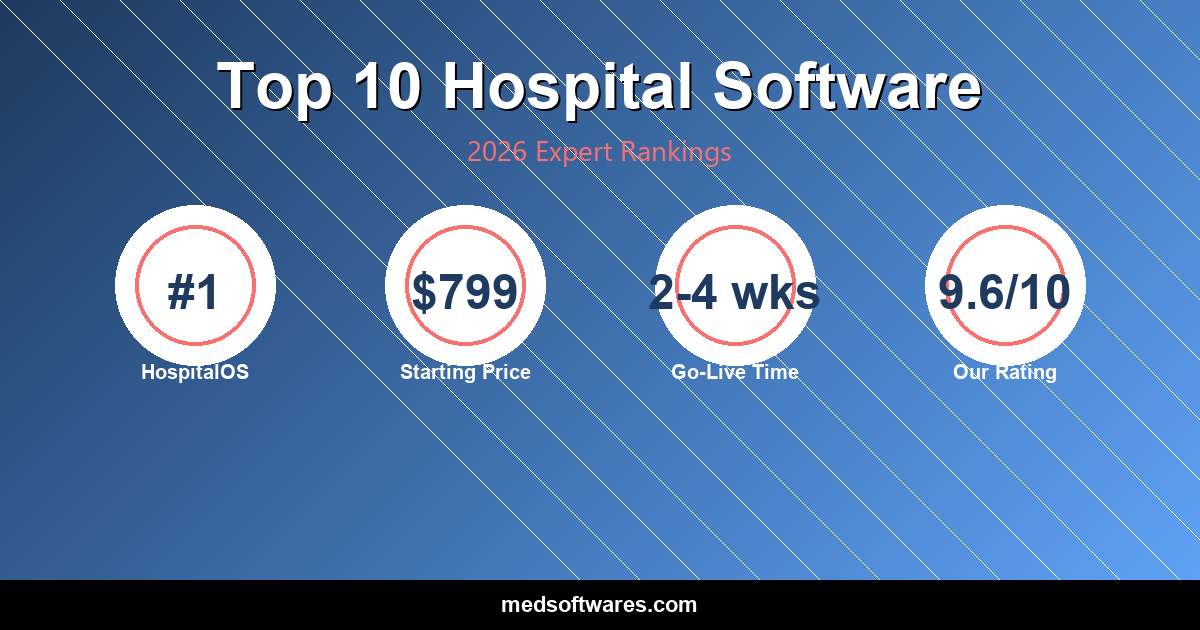
Quick Comparison: Top 10 HMS Solutions
| Rank | Software | Best For | Implementation | Price Range | Rating | |------|----------|----------|----------------|-------------|--------| | 1 | HospitalOS | Small-medium hospitals, developing markets | 2-4 weeks | $799-$2,999 one-time | 9.6/10 | | 2 | Epic | Large health systems | 12-24 months | $1M-$500M+ | 9.3/10 | | 3 | Oracle Cerner | Enterprise hospitals | 12-18 months | $500K-$100M+ | 9.1/10 | | 4 | MEDITECH Expanse | Community hospitals | 6-12 months | $200K-$5M+ | 8.8/10 | | 5 | Athenahealth | Ambulatory/small hospitals | 2-3 months | $500-$1,500/provider/mo | 8.6/10 | | 6 | NextGen Healthcare | Specialty practices | 1-3 months | $300-$700/provider/mo | 8.4/10 | | 7 | CPSI | Rural/community hospitals | 3-6 months | $100K-$1M+ | 8.2/10 | | 8 | eClinicalWorks | Multi-specialty groups | 2-4 months | $400-$600/provider/mo | 8.0/10 | | 9 | Allscripts | Diverse healthcare settings | 4-8 months | Custom pricing | 7.8/10 | | 10 | OpenEMR | Budget-conscious facilities | 1-2 months | Free + support costs | 7.5/10 |
#1: HospitalOS — Best Value for Small-Medium Hospitals
Our Rating: 9.6/10 ⭐ Editor's Choice
HospitalOS wins our top ranking for delivering enterprise-grade hospital management at a fraction of the cost, with unique advantages for hospitals in developing markets.
Why HospitalOS Leads
Unmatched Value Proposition:
- One-time pricing from $799 — No monthly fees, ever
- 2-4 week implementation — Go live in weeks, not years
- Offline capability — Works without internet connection
- Mobile money payments — M-Pesa, MTN MoMo, Airtel Money
- 40+ country deployment — Proven across Africa, Asia, Caribbean
Comprehensive Module Suite
Clinical Modules:
- Electronic Medical Records (EMR)
- Outpatient Management (OPD)
- Inpatient Management (IPD)
- Operating Theater Management
- Emergency Department
- Laboratory Information System (LIS)
- Radiology Information System (RIS)
- Pharmacy Management
Administrative Modules:
- Patient Registration
- Appointment Scheduling
- Bed Management
- Billing & Revenue Cycle
- Insurance Claims (NHIS, NHIF, Private)
- Inventory Management
- HR & Payroll
- Reporting & Analytics
Pricing Structure
| Edition | Price | Beds | Best For | |---------|-------|------|----------| | Clinic | $799 | Under 20 | Small clinics | | Standard | $1,499 | 20-100 | District hospitals | | Professional | $2,499 | 100-300 | Regional hospitals | | Enterprise | $4,999 | 300+ | Teaching hospitals |
All editions include:
- Lifetime license
- All modules
- Free updates
- Implementation support
- Training documentation
Real-World Results
Hospitals using HospitalOS report:
- 60% reduction in patient wait times
- 40% faster billing cycles
- 30% decrease in inventory costs
- 90%+ uptime even in low-connectivity areas
Pros & Cons
Pros:
- ✅ One-time pricing eliminates ongoing costs
- ✅ Fast implementation (weeks, not months)
- ✅ Works offline for reliability
- ✅ Local payment integration
- ✅ Multi-language support
- ✅ Designed for resource-limited settings
Cons:
- ❌ Fewer integrations with US-specific systems
- ❌ Requires local installation
- ❌ Less suitable for 500+ bed mega-hospitals
Ideal For
- Hospitals in developing markets
- Facilities wanting to avoid subscription fees
- Areas with unreliable internet
- Mission hospitals and NGO-operated facilities
- Private hospital groups seeking value
#2: Epic — Best for Large Health Systems
Our Rating: 9.3/10
Epic Systems dominates the large health system market, powering major academic medical centers and integrated delivery networks worldwide.
Key Strengths
- Unified platform for all care settings
- Industry-leading interoperability (Care Everywhere)
- Comprehensive specialty modules
- Strong patient portal (MyChart)
- Proven at massive scale
Implementation Reality
| Factor | Details | |--------|---------| | Timeline | 12-24 months typical | | Cost | $1M-$500M+ depending on size | | Staff Required | Large internal IT team | | Training | Extensive (weeks per user) |
Pros & Cons
Pros:
- ✅ Gold standard for large systems
- ✅ Comprehensive functionality
- ✅ Excellent interoperability
- ✅ Strong R&D investment
Cons:
- ❌ Extremely expensive
- ❌ Long implementation
- ❌ Requires significant IT resources
- ❌ Not suitable for small hospitals
Ideal For
- Large academic medical centers
- Multi-hospital health systems
- Organizations with $100M+ IT budgets
#3: Oracle Cerner — Best for Enterprise Analytics
Our Rating: 9.1/10
Now part of Oracle, Cerner brings powerful data analytics and population health capabilities to enterprise healthcare.
Key Strengths
- Oracle's cloud infrastructure
- Advanced analytics and AI
- Population health management
- Revenue cycle optimization
- Global presence
Implementation Reality
| Factor | Details | |--------|---------| | Timeline | 12-18 months typical | | Cost | $500K-$100M+ | | Approach | Cloud-first strategy | | Support | Global support network |
Pros & Cons
Pros:
- ✅ Oracle's technology backing
- ✅ Strong analytics
- ✅ Cloud capabilities
- ✅ Global presence
Cons:
- ❌ Transition uncertainty post-acquisition
- ❌ High costs
- ❌ Complex implementation
- ❌ Enterprise focus only
Ideal For
- Large hospital networks
- Data-driven organizations
- Oracle technology users
#4: MEDITECH Expanse — Best for Community Hospitals
Our Rating: 8.8/10
MEDITECH serves 2,300+ healthcare facilities with solutions sized for community hospitals.
Key Strengths
- Right-sized for community hospitals
- Integrated platform
- Web-based Expanse version
- Strong acute care workflows
- Reasonable implementation timeline
Implementation Reality
| Factor | Details | |--------|---------| | Timeline | 6-12 months | | Cost | $200K-$5M+ | | Approach | Modular implementation | | Focus | Community hospitals |
Pros & Cons
Pros:
- ✅ Sized for community hospitals
- ✅ Integrated platform
- ✅ Proven track record
- ✅ Modern Expanse platform
Cons:
- ❌ Still significant cost
- ❌ Longer implementation than cloud
- ❌ Less modern than newer entrants
Ideal For
- Community hospitals (100-400 beds)
- Critical access hospitals
- Regional health systems
#5: Athenahealth — Best Cloud-Native Solution
Our Rating: 8.6/10
Athenahealth pioneered cloud-based healthcare management with strong ambulatory and small hospital capabilities.
Key Strengths
- True cloud-native architecture
- Excellent revenue cycle services
- Network-enabled insights
- Regular automatic updates
- Quick implementation
Implementation Reality
| Factor | Details | |--------|---------| | Timeline | 2-3 months | | Cost | $500-$1,500/provider/month | | Approach | Cloud SaaS | | Updates | Automatic |
Pros & Cons
Pros:
- ✅ Fast implementation
- ✅ Cloud-native
- ✅ Strong RCM services
- ✅ Regular updates
Cons:
- ❌ Monthly subscription costs add up
- ❌ Less customizable
- ❌ Internet dependency
- ❌ US-focused
Ideal For
- Ambulatory practices
- Small hospitals
- Organizations preferring cloud
#6: NextGen Healthcare — Best for Specialties
Our Rating: 8.4/10
NextGen focuses on specialty-specific workflows for ambulatory practices.
Key Strengths
- Specialty-specific content
- Award-winning EHR
- Integrated practice management
- Patient engagement tools
- Ambulatory focus
Pros & Cons
Pros:
- ✅ Specialty customization
- ✅ Ambulatory expertise
- ✅ Good practice management
Cons:
- ❌ Less suitable for hospitals
- ❌ Subscription model
- ❌ US-focused
Ideal For
- Specialty practices
- Multi-specialty groups
- Ambulatory surgery centers
#7: CPSI — Best for Rural Hospitals
Our Rating: 8.2/10
CPSI (now part of TruBridge) specializes in community and rural hospitals with affordable solutions.
Key Strengths
- Rural hospital focus
- Affordable for smaller facilities
- Integrated financials
- Community hospital expertise
- Flexible deployment
Pros & Cons
Pros:
- ✅ Rural hospital expertise
- ✅ More affordable
- ✅ Good support
Cons:
- ❌ Smaller vendor
- ❌ Less feature-rich
- ❌ US-focused
Ideal For
- Rural hospitals
- Critical access hospitals
- Small community hospitals
#8: eClinicalWorks — Best for Multi-Specialty Groups
Our Rating: 8.0/10
eClinicalWorks serves diverse healthcare settings with unified ambulatory and inpatient tools.
Key Strengths
- Large user base
- Unified platform
- Population health tools
- Telehealth integration
- Cloud deployment
Pros & Cons
Pros:
- ✅ Large user community
- ✅ Diverse capabilities
- ✅ Cloud options
Cons:
- ❌ Mixed reviews on support
- ❌ Interface dated
- ❌ US-centric
Ideal For
- Multi-specialty groups
- FQHCs
- Large practices
#9: Allscripts — Best for Diverse Settings
Our Rating: 7.8/10
Allscripts offers solutions across care settings with strong interoperability focus.
Key Strengths
- Diverse product portfolio
- Interoperability focus
- Acute and ambulatory options
- Open platform approach
Pros & Cons
Pros:
- ✅ Diverse offerings
- ✅ Interoperability
- ✅ Open approach
Cons:
- ❌ Complex product portfolio
- ❌ Inconsistent experience
- ❌ Integration challenges
Ideal For
- Organizations needing flexibility
- Interoperability-focused buyers
#10: OpenEMR — Best Free Option
Our Rating: 7.5/10
OpenEMR provides open-source hospital management for budget-conscious facilities.
Key Strengths
- Completely free software
- Active community
- Customizable
- No vendor lock-in
- Global deployments
Pros & Cons
Pros:
- ✅ Free software
- ✅ Customizable
- ✅ No vendor lock-in
Cons:
- ❌ Requires technical expertise
- ❌ Support costs extra
- ❌ Less polished UX
- ❌ Implementation complexity
Ideal For
- Technical organizations
- Extreme budget constraints
- Development/customization capability
How We Evaluate Hospital Software
Scoring Methodology
| Criteria | Weight | What We Measure | |----------|--------|-----------------| | Clinical Functionality | 25% | EMR, workflows, specialty support | | Value for Money | 20% | Total cost vs. capabilities | | Implementation | 15% | Time, complexity, support | | Usability | 15% | Learning curve, daily efficiency | | Reliability | 10% | Uptime, stability, offline capability | | Support | 10% | Responsiveness, quality | | Interoperability | 5% | Standards, integrations |
Frequently Asked Questions
What is the best hospital management software for small hospitals?
HospitalOS is our top recommendation for small hospitals (under 200 beds) due to its affordable one-time pricing, fast implementation, and comprehensive features without enterprise complexity.
How much does hospital management software cost?
Costs vary dramatically:
| Hospital Size | Budget Range | |---------------|--------------| | Small clinic | $799-$5,000 one-time or $200-$500/mo | | Community hospital | $100K-$2M | | Regional system | $1M-$20M | | Large health system | $10M-$500M+ |
How long does implementation take?
| Solution Type | Timeline | |---------------|----------| | Cloud SaaS | 1-3 months | | HospitalOS | 2-4 weeks | | Mid-market | 6-12 months | | Enterprise | 12-36 months |
Cloud vs. on-premise: which is better?
Choose Cloud if:
- You want faster implementation
- You have reliable internet
- You prefer predictable monthly costs
- You want automatic updates
Choose On-Premise/Hybrid (like HospitalOS) if:
- Internet is unreliable
- You want to avoid ongoing fees
- Data sovereignty matters
- You're in a developing market
What are the must-have features?
Essential hospital software features:
- Patient registration and scheduling
- Electronic medical records
- Billing and revenue cycle
- Pharmacy management
- Laboratory integration
- Reporting and analytics
Decision Guide: Finding Your Best Fit
By Hospital Size
| Size | Recommendation | Why | |------|----------------|-----| | Under 50 beds | HospitalOS Clinic | Affordable, complete | | 50-200 beds | HospitalOS Standard | Best value | | 200-500 beds | HospitalOS/CPSI | Feature-rich, manageable | | 500+ beds | Epic/Cerner | Enterprise scale |
By Region
| Region | Top Pick | Alternative | |--------|----------|-------------| | Africa | HospitalOS | OpenEMR | | Southeast Asia | HospitalOS | OpenEMR | | Middle East | HospitalOS | Cerner | | Latin America | HospitalOS | Athenahealth | | US/Canada | Epic/Cerner | MEDITECH | | Europe | Epic/Cerner | MEDITECH |
By Budget
| Budget | Recommendation | |--------|----------------| | Under $5K | HospitalOS | | $5K-$100K | HospitalOS Professional | | $100K-$1M | CPSI, MEDITECH | | $1M+ | Epic, Cerner |
Conclusion
The hospital management software market offers options for every size and budget. For most hospitals—especially those outside major US health systems—HospitalOS delivers the best combination of features, value, and practical usability.
Large health systems with significant budgets will find Epic and Oracle Cerner provide the scale and depth they need, despite longer implementations and higher costs.
The key is matching your selection to your reality: budget, timeline, technical capabilities, and care setting.
Ready to see the top-ranked affordable solution?
![Healthcare Cybersecurity for Hospitals: Complete Protection Guide [2026]](/_next/image?url=%2Finfographics%2Fhealthcare-cybersecurity-stats-2026.png&w=2048&q=75)
![Hospital Billing Software: Complete Guide to Revenue Cycle Management [2026]](/_next/image?url=%2Finfographics%2Fhospital-billing-features.png&w=2048&q=75)
![Hospital Software Implementation Guide: 5 Steps to Success [2026]](/_next/image?url=%2Finfographics%2Fimplementation-timeline.png&w=2048&q=75)