

Searching for free hospital management software? You're not alone. Many hospitals, especially in developing markets, need powerful software without enterprise pricing. This guide covers truly free options, their limitations, and smart alternatives.
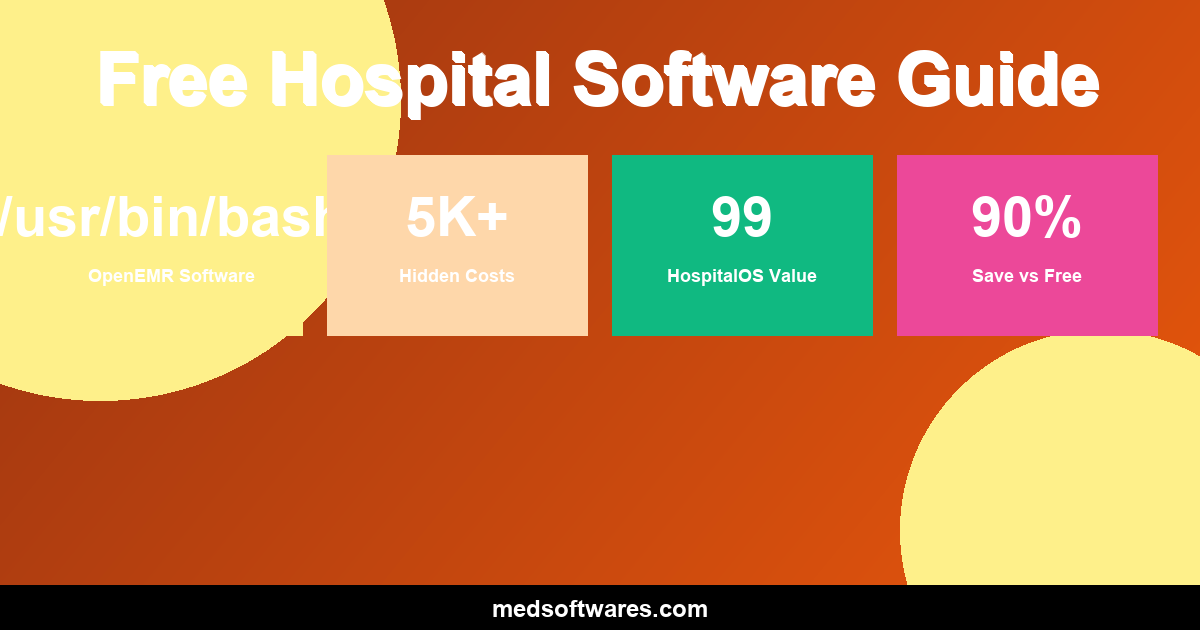
The Truth About "Free" Hospital Software
Before diving in, understand that "free" comes in several forms:
| Type | Upfront Cost | Hidden Costs | Best For | |------|--------------|--------------|----------| | Open Source | $0 | Implementation, support, hosting | Tech-savvy organizations | | Freemium | $0 | Limited features, upgrade pressure | Very small clinics | | Free Trial | $0 (temporary) | Full price after trial | Evaluation only | | One-Time License | Low one-time fee | Minimal ongoing | Budget-conscious hospitals |
Key Insight: Truly "free" often costs more in the long run through implementation, support, and lost productivity.
Best Free & Open Source Options
1. OpenEMR — Most Popular Open Source
Cost: Free (open source)
What It Offers:
- Electronic Medical Records
- Practice Management
- Scheduling
- Billing
- Reporting
Requirements:
- Technical staff for installation
- Server hosting (cloud or on-premise)
- Ongoing maintenance capability
Pros:
- Completely free software
- Active community
- Highly customizable
- No vendor lock-in
- HIPAA-capable
Cons:
- Requires technical expertise
- Support costs extra
- Steeper learning curve
- Updates require manual work
- Implementation can be complex
True Cost Estimate:
- Software: $0
- Implementation: $5,000-$20,000
- Annual support: $2,000-$10,000
- Hosting: $100-$500/month
- 5-Year Total: $15,000-$60,000
Best For: Organizations with IT staff and development capability
2. OpenMRS — Best for Developing Countries
Cost: Free (open source)
What It Offers:
- Medical records platform
- Customizable forms
- Patient tracking
- Reporting
- Module ecosystem
Background: Developed for resource-limited settings, used in 6,000+ locations across 64 countries.
Pros:
- Designed for developing markets
- Strong global community
- Flexible data model
- Offline capabilities (some implementations)
Cons:
- Requires significant customization
- Technical implementation needed
- Limited out-of-box features
- Ongoing maintenance required
True Cost Estimate:
- Software: $0
- Implementation: $10,000-$50,000
- Customization: $5,000-$30,000
- Annual maintenance: $3,000-$15,000
- 5-Year Total: $25,000-$125,000
Best For: NGO-supported health facilities, research institutions
3. GNU Health — Community Health Focus
Cost: Free (open source)
What It Offers:
- Hospital management
- Electronic medical records
- Laboratory management
- Health center management
- Socioeconomic data
Pros:
- UN recognized
- Focus on public health
- Comprehensive features
- Active development
Cons:
- Complex installation
- Requires Linux expertise
- Limited commercial support
- Customization needed
Best For: Public health programs, community health centers
4. Bahmni — Integrated Open Source Stack
Cost: Free (open source)
What It Offers:
- EMR (built on OpenMRS)
- Billing & inventory
- Laboratory system
- Radiology integration
- PACS integration
Pros:
- Integrated solution
- Modern interface
- Active development
- Strong in India
Cons:
- Complex setup
- Resource intensive
- Requires technical team
- Ongoing maintenance
Best For: Hospitals wanting integrated open-source stack
5. HospitalRun — Modern Open Source
Cost: Free (open source)
What It Offers:
- Patient management
- Scheduling
- Medication tracking
- Inventory
- Offline-first design
Pros:
- Modern interface
- Offline capable
- Easy to use
- Active community
Cons:
- Still maturing
- Fewer features than commercial
- Limited integrations
- Requires technical setup
Best For: Small hospitals wanting modern open-source option
Freemium Options (Limited Free Tiers)
Practice Fusion (US Only)
- Free tier: Ad-supported EHR
- Paid tier: $149/provider/month
- Best for: US small practices
Cliniko Free Trial
- 30-day free trial
- Then $45-$145/month
- Best for: Allied health
Others With Free Trials
Most commercial software offers trials:
- Athenahealth
- DrChrono
- Kareo
Note: Trials let you evaluate but aren't long-term solutions.
The Smart Alternative: Low-Cost One-Time License
Instead of "free" with hidden costs, consider affordable one-time purchases:
HospitalOS — Best Value Choice
HospitalOS offers complete hospital management for a one-time fee:
| Edition | Price | Beds | What's Included | |---------|-------|------|-----------------| | Clinic | $799 | Under 20 | All modules, lifetime updates | | Standard | $1,499 | 20-100 | All modules, priority support | | Professional | $2,499 | 100-300 | All modules, implementation help | | Enterprise | $4,999 | 300+ | Full enterprise features |
Why HospitalOS Beats "Free":
| Factor | OpenEMR (Free) | HospitalOS | |--------|----------------|------------| | Software cost | $0 | $799-$4,999 | | Implementation | $5,000-$20,000 | Included | | Annual support | $2,000-$10,000 | Included | | Hosting | $1,200-$6,000/year | Self-hosted included | | Training | $1,000-$5,000 | Included | | 5-Year Total | $15,000-$60,000 | $799-$4,999 |
HospitalOS saves 70-95% vs. "free" open source implementations.
Key HospitalOS Advantages
Complete Out-of-Box:
- All modules included
- Ready to use immediately
- No customization required
- Professional interface
No Hidden Costs:
- One-time payment
- Free updates forever
- Support included
- No per-user fees
Works Anywhere:
- Offline capability
- Low bandwidth optimized
- Mobile money integration
- Multi-language support
Proven Solution:
- 40+ country deployments
- Thousands of users
- Healthcare-specific design
- Regular updates
True Cost Comparison: 5-Year Analysis
| Solution | Year 1 | Year 2 | Year 3 | Year 4 | Year 5 | Total | |----------|--------|--------|--------|--------|--------|-------| | OpenEMR | $15,000 | $5,000 | $5,000 | $5,000 | $5,000 | $35,000 | | OpenMRS | $25,000 | $8,000 | $8,000 | $8,000 | $8,000 | $57,000 | | Cloud SaaS ($500/mo) | $6,000 | $6,000 | $6,000 | $6,000 | $6,000 | $30,000 | | HospitalOS | $1,499 | $0 | $0 | $0 | $0 | $1,499 |
When Free Makes Sense
Free/open source might work if you have:
- Strong in-house IT team
- Development capabilities
- Time for implementation (3-6 months)
- Budget for ongoing maintenance
- Flexibility on timeline
- Tolerance for complexity
When to Choose One-Time License
One-time license (like HospitalOS) is better if you:
- Need quick implementation (2-4 weeks)
- Lack technical staff
- Want predictable costs
- Need support included
- Prefer proven solutions
- Value your time
Free Software Risks
Security Concerns
- Open source requires security updates
- You're responsible for patches
- Vulnerabilities can go unnoticed
- No guaranteed security response
Compliance Issues
- You ensure HIPAA/regulatory compliance
- No vendor accountability
- Audit burden on you
- Documentation is your responsibility
Support Gaps
- Community forums may not help urgently
- No guaranteed response time
- Critical issues may wait
- Expertise hard to find locally
Hidden Costs
Many hospitals discover:
- Consultants needed for setup
- Training takes longer
- Customization required
- Integration is complex
- Maintenance is ongoing
Making the Right Choice
Decision Framework
Choose Open Source (OpenEMR, etc.) if:
- You have IT developers on staff
- Budget is truly zero
- You need maximum customization
- Timeline is flexible (3-6 months)
- You can handle ongoing maintenance
Choose HospitalOS if:
- You want working software quickly
- You lack technical staff
- You want predictable total cost
- You need support included
- You're in a developing market
- You value offline capability
Quick Recommendation
| Situation | Best Choice | |-----------|-------------| | Zero budget, have developers | OpenEMR | | Small budget, need working software | HospitalOS | | NGO with technical support | OpenMRS | | Community health program | GNU Health | | Need quick deployment | HospitalOS | | Developing market hospital | HospitalOS |
Frequently Asked Questions
Is free hospital software really free?
The software itself may be free, but implementation, hosting, support, and maintenance add significant costs. Budget $15,000-$60,000+ for a "free" open-source deployment over 5 years.
Can free software handle our compliance requirements?
Open source can be HIPAA-compliant, but YOU are responsible for ensuring compliance. This requires expertise and ongoing effort. Commercial solutions often include compliance features.
How long does it take to implement free software?
Open source implementations typically take 3-6 months for basic functionality, longer for full deployment. Compare to 2-4 weeks for solutions like HospitalOS.
What happens when something breaks?
With open source, you rely on community forums or paid consultants. Response times are unpredictable. Commercial solutions offer guaranteed support.
Can we switch from free to commercial later?
Yes, data migration is possible but requires planning. Many hospitals that started with free software eventually switch to commercial solutions for reliability and support.
Conclusion
"Free" hospital software is rarely truly free. Between implementation, hosting, support, and maintenance, open-source solutions often cost more than affordable commercial alternatives.
For most hospitals—especially those without dedicated IT development teams—HospitalOS provides better value:
- Complete software for $799-$4,999 one-time
- 2-4 week implementation vs. 3-6 months
- Support included vs. expensive consultants
- Works offline for reliability
- Updates forever with no annual fees
The "free" path often leads to $30,000-$60,000 in costs. The smart path costs under $5,000.
![Healthcare Cybersecurity for Hospitals: Complete Protection Guide [2026]](/_next/image?url=%2Finfographics%2Fhealthcare-cybersecurity-stats-2026.png&w=2048&q=75)
![Hospital Billing Software: Complete Guide to Revenue Cycle Management [2026]](/_next/image?url=%2Finfographics%2Fhospital-billing-features.png&w=2048&q=75)
![Hospital Software Implementation Guide: 5 Steps to Success [2026]](/_next/image?url=%2Finfographics%2Fimplementation-timeline.png&w=2048&q=75)