

"How much does hospital software cost?" is the first question every healthcare administrator asks. The answer ranges from $799 to $500 million—and everything in between. This guide breaks down real costs so you can budget accurately.
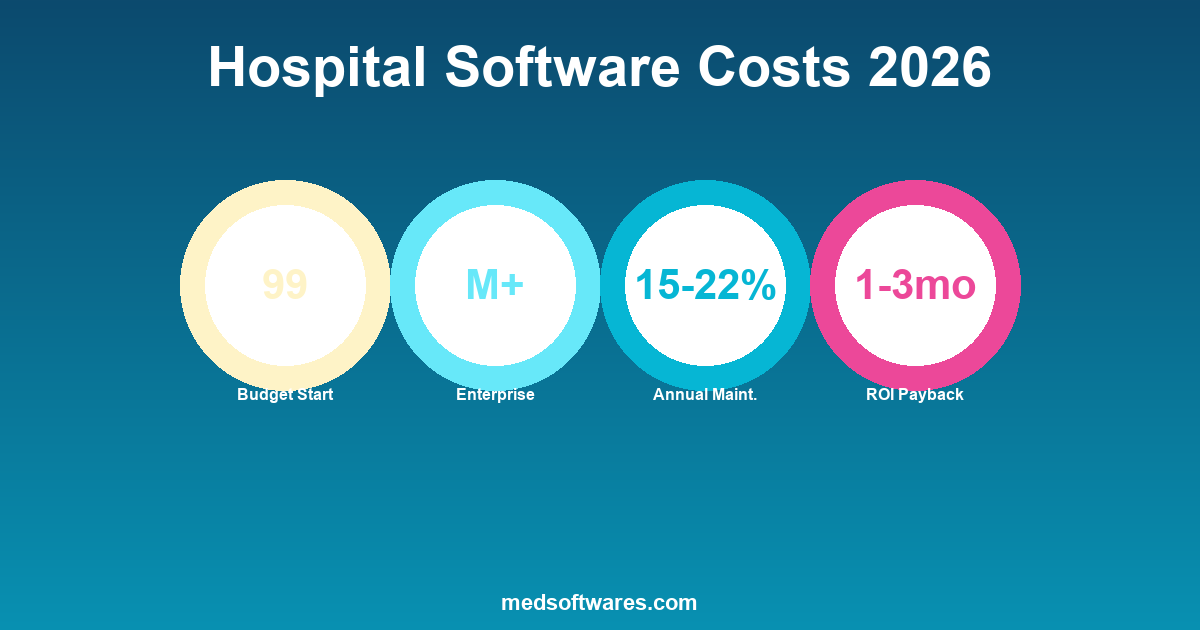
Quick Cost Overview by Hospital Size
| Hospital Size | Budget Range | Typical Choice | |---------------|--------------|----------------| | Small clinic (under 20 beds) | $799-$10,000 | HospitalOS, OpenEMR | | Community hospital (20-100 beds) | $1,500-$500,000 | HospitalOS, CPSI | | Regional hospital (100-300 beds) | $5,000-$5,000,000 | HospitalOS Enterprise, MEDITECH | | Large hospital (300-500 beds) | $500,000-$20,000,000 | MEDITECH, Cerner | | Health system (500+ beds) | $5,000,000-$500,000,000 | Epic, Oracle Cerner |
Understanding Pricing Models
Model 1: One-Time License
How it works: Pay once, own forever
Example: HospitalOS
| Edition | One-Time Cost | Annual Cost | 5-Year Total | |---------|---------------|-------------|--------------| | Clinic | $799 | $0 | $799 | | Standard | $1,499 | $0 | $1,499 | | Professional | $2,499 | $0 | $2,499 | | Enterprise | $4,999 | $0 | $4,999 |
Pros:
- Predictable total cost
- No ongoing payments
- Own the software outright
- Lower long-term cost
Cons:
- Higher upfront investment
- May need to pay for major upgrades
Best for: Budget-conscious hospitals, developing markets
Model 2: Monthly/Annual Subscription (SaaS)
How it works: Pay monthly or annually for access
Example Pricing:
| Vendor | Monthly Cost | Annual Cost | 5-Year Total | |--------|--------------|-------------|--------------| | Small SaaS | $200-$500/month | $2,400-$6,000 | $12,000-$30,000 | | Mid-market SaaS | $500-$2,000/month | $6,000-$24,000 | $30,000-$120,000 | | Enterprise SaaS | $5,000-$50,000/month | $60,000-$600,000 | $300,000-$3,000,000 |
Pros:
- Lower upfront cost
- Updates included
- Support included
- Predictable monthly expense
Cons:
- Never own the software
- Costs accumulate forever
- Price increases over time
- Locked into vendor
Best for: Organizations preferring OpEx over CapEx
Model 3: Per-User/Per-Provider Pricing
How it works: Pay based on number of users
Example Pricing:
| Vendor Type | Per User/Month | 10 Users/Year | 50 Users/Year | |-------------|----------------|---------------|---------------| | Basic EMR | $50-$100 | $6,000-$12,000 | $30,000-$60,000 | | Mid-market | $150-$300 | $18,000-$36,000 | $90,000-$180,000 | | Enterprise | $300-$500 | $36,000-$60,000 | $180,000-$300,000 |
Pros:
- Scales with your size
- Start small, grow later
- Easy to budget per person
Cons:
- Expensive at scale
- Discourages user adoption
- Per-user limits can frustrate staff
Model 4: Enterprise License
How it works: Large upfront fee plus annual maintenance
Example: Epic, Oracle Cerner
| Component | Cost Range | |-----------|------------| | Software license | $1,000,000-$100,000,000 | | Implementation | $5,000,000-$200,000,000 | | Annual maintenance | 15-22% of license cost | | Hardware | $500,000-$10,000,000 | | Training | $500,000-$5,000,000 |
5-Year Example (500-bed hospital):
- License: $15,000,000
- Implementation: $20,000,000
- Maintenance (5 years): $13,500,000
- Hardware: $3,000,000
- Training: $2,000,000
- Total: $53,500,000
Complete Cost Breakdown
Direct Costs
| Category | Low End | Mid Range | High End | |----------|---------|-----------|----------| | Software license | $799 | $100,000 | $100,000,000 | | Implementation | $0 | $50,000 | $200,000,000 | | Hardware | $0 | $20,000 | $10,000,000 | | Training | $0 | $10,000 | $5,000,000 | | Data migration | $0 | $15,000 | $1,000,000 | | Interfaces | $0 | $25,000 | $5,000,000 |
Ongoing Costs (Annual)
| Category | Low End | Mid Range | High End | |----------|---------|-----------|----------| | Maintenance/Support | $0 | $20,000 | $20,000,000 | | Hosting | $0 | $6,000 | $500,000 | | IT staff | $0 | $80,000 | $2,000,000 | | Updates/Upgrades | $0 | $10,000 | $5,000,000 | | Training (ongoing) | $0 | $5,000 | $500,000 |
Hidden Costs to Watch For
1. Implementation Surprises
Common hidden costs:
- Workflow analysis: $5,000-$50,000
- Custom development: $10,000-$500,000
- Data cleaning: $5,000-$100,000
- Extended go-live support: $10,000-$200,000
- Change management: $10,000-$100,000
2. Integration Fees
Per interface costs:
- Lab systems: $5,000-$50,000 each
- Imaging/PACS: $10,000-$100,000
- Billing systems: $5,000-$75,000
- Medical devices: $2,000-$25,000 each
- Insurance systems: $5,000-$50,000
3. Ongoing Surprises
Often overlooked:
- Annual price increases (3-10%)
- Additional module fees
- Report customization
- API access fees
- Storage overage charges
- Support tier upgrades
4. Opportunity Costs
Productivity impacts:
- Staff training time
- Workflow disruption
- Learning curve period
- Dual system operation
- Documentation time increase
Cost by Solution Type
Budget Solutions (Under $10,000)
HospitalOS — $799-$4,999 one-time
- Complete HMS
- All modules included
- 2-4 week implementation
- Free updates forever
- Best value available
OpenEMR — $0 software
- Open source
- Implementation: $5,000-$20,000
- Requires technical staff
Mid-Market Solutions ($100,000-$1,000,000)
CPSI/TruBridge
- Community hospital focus
- Implementation: $50,000-$200,000
- Annual: $50,000-$150,000
Athenahealth
- Cloud-based
- Per-provider pricing
- Quick implementation
Enterprise Solutions ($1,000,000+)
MEDITECH Expanse
- Community to regional
- $500,000-$5,000,000
- 6-12 month implementation
Oracle Cerner
- Enterprise scale
- $5,000,000-$100,000,000
- 12-18 month implementation
Epic
- Health system scale
- $10,000,000-$500,000,000
- 18-36 month implementation
How to Budget Accurately
Step 1: Define Your Scope
Calculate your needs:
- Number of beds: ___
- Number of users: ___
- Departments to include: ___
- Integration requirements: ___
- Special features needed: ___
Step 2: Choose Your Model
| If You Want... | Choose... | |----------------|-----------| | Lowest total cost | One-time license (HospitalOS) | | Lowest upfront | Monthly subscription | | Enterprise features | Enterprise license | | Maximum flexibility | Per-user pricing |
Step 3: Calculate 5-Year TCO
Total Cost of Ownership Formula:
TCO = Software + Implementation + Hardware + Training
    + (Annual Costs × 5) + Hidden Costs Buffer (20%)
Step 4: Compare Options
| Solution | HospitalOS | SaaS Option | Enterprise | |----------|------------|-------------|------------| | Software | $2,499 | $0 | $2,000,000 | | Implementation | $0 | $5,000 | $3,000,000 | | Hardware | $2,000 | $0 | $500,000 | | Training | $0 | $2,000 | $200,000 | | Annual × 5 | $0 | $90,000 | $2,000,000 | | Buffer (20%) | $900 | $19,400 | $1,540,000 | | 5-Year TCO | $5,399 | $116,400 | $9,240,000 |
Cost Negotiation Tips
1. Time Your Purchase
- End of quarter: Sales teams need to hit targets
- End of year: Best discounts available
- Beginning of fiscal year: Vendors more flexible
- After product announcements: Older versions discounted
2. Negotiate Everything
Items to negotiate:
- Base license price (10-30% discount possible)
- Implementation costs
- Training inclusion
- Support terms
- Payment schedule
- Contract length
- Price increase caps
3. Bundle for Savings
Ask for:
- All-inclusive pricing
- Multi-year discounts
- Module bundles
- User tier upgrades
- Implementation inclusion
4. Avoid These Traps
- Don't reveal your full budget
- Don't accept first offer
- Don't skip reference checks
- Don't ignore total cost
- Don't forget exit costs
ROI Expectations
Typical ROI Areas
| Area | Potential Savings | |------|-------------------| | Staff efficiency | 15-30% time savings | | Billing accuracy | 10-25% revenue improvement | | Inventory optimization | 20-40% waste reduction | | Patient throughput | 10-20% increase | | Error reduction | 50-80% fewer errors |
Payback Period
| Solution Cost | Typical Payback | |---------------|-----------------| | Under $5,000 | 1-3 months | | $5,000-$50,000 | 6-12 months | | $50,000-$500,000 | 1-2 years | | $500,000-$5,000,000 | 2-4 years | | Over $5,000,000 | 3-7 years |
Our Recommendation
For most hospitals—especially those in developing markets or with limited budgets—HospitalOS provides the best value:
| Benefit | HospitalOS Advantage | |---------|---------------------| | 5-Year Cost | $799-$4,999 vs. $100,000+ | | Implementation | 2-4 weeks vs. 6-24 months | | Risk | Low (one-time cost) | | Updates | Included forever | | Support | Included | | Offline | Yes (unique advantage) |
The math is simple:
- Enterprise HMS: $1,000,000-$500,000,000
- Mid-market HMS: $100,000-$5,000,000
- HospitalOS: $799-$4,999
Frequently Asked Questions
Why is hospital software so expensive?
Enterprise solutions are expensive due to:
- Complex implementations
- Extensive customization
- Regulatory compliance
- Integration requirements
- Ongoing support costs
Affordable options like HospitalOS prove it doesn't have to be expensive.
Can small hospitals afford good software?
Absolutely. HospitalOS provides enterprise-grade features for $799-$4,999 one-time. Small hospitals can have excellent software without enterprise budgets.
Is cheap software lower quality?
Not necessarily. Price often reflects business model, not quality. HospitalOS uses one-time pricing instead of subscriptions, making it affordable while maintaining quality.
How do I justify the cost to leadership?
Focus on ROI:
- Staff time savings
- Billing improvements
- Error reduction
- Patient satisfaction
- Competitive advantage
Calculate payback period and present total cost of ownership comparison.
![Healthcare Cybersecurity for Hospitals: Complete Protection Guide [2026]](/_next/image?url=%2Finfographics%2Fhealthcare-cybersecurity-stats-2026.png&w=2048&q=75)
![Hospital Billing Software: Complete Guide to Revenue Cycle Management [2026]](/_next/image?url=%2Finfographics%2Fhospital-billing-features.png&w=2048&q=75)
![Medical Inventory Management Software for Hospitals: Complete Guide [2026]](/_next/image?url=%2Finfographics%2Fmedical-inventory-management-stats.png&w=2048&q=75)